T38 Drifter Rod Buying Guide: What You Need to Know
T38 Drifter Rod Buying Guide: What You Need to Know
If you work in underground mining, tunnel drifting, or rock drilling, you probably know that the drill string matters. The T38 drifter rod is one of the most important parts. It connects the rock drill to the drill bit and passes impact energy into the rock. If the rod is good, drilling is faster and costs are lower. If the rod is bad, you lose time, money, and productivity.
This guide explains T38 drifter rods in simple terms: what they are, the main types, common sizes, how they are made, and how to choose and maintain them.
What Is a T38 Drifter Rod?
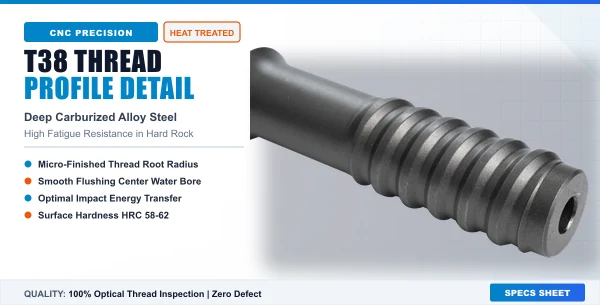
A T38 drifter rod is a threaded drill rod used for medium to large hole drilling. The “T38” means it uses a 38mm trapezoidal thread.
Why does that matter? Because this thread is strong, wears well, and can handle high impact and high torque from modern rock drills. It also connects and disconnects fairly easily.
T38 rods are usually used for hole diameters from 64mm to 102mm (2.5 to 4 inches) . You will often see them on hydraulic jumbo drills like Sandvik DD series and Epiroc Boomer series.
Two Main Types of T38 Drifter Rods
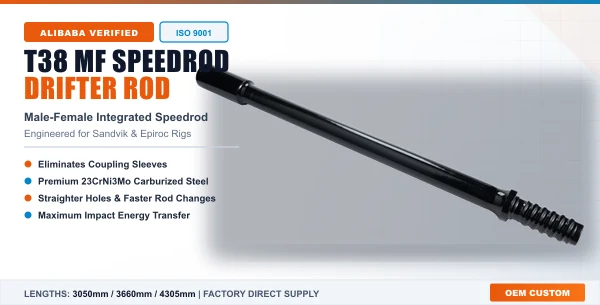
1. T38 MF Rod (Male-Female) / Speed Rod
This is the most common type for modern automated drilling.
- One end is male thread.
- The other end is female thread.
- No coupling sleeve needed.
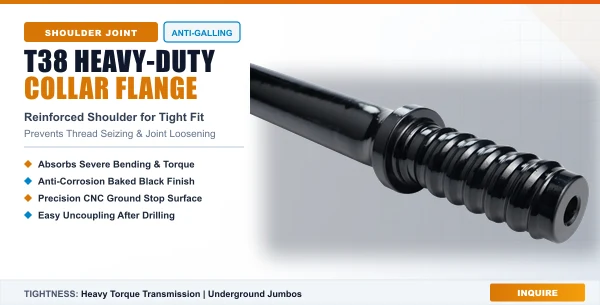
Why people like it:
Fewer connections mean better energy transfer. That means faster drilling and less energy loss. It also saves time when adding or removing rods.
2. T38 MM Rod (Male-Male) + Coupling Sleeve
This type uses a coupling sleeve.
- Both ends are male thread.
- You must use a T38 coupling sleeve to connect rods.
Why people use it:
If one end wears out, you can flip the rod or replace the sleeve. In some manual or semi-automatic operations, this can save money.
Common T38 Rod Sizes
T38 rods come in different body shapes and sizes. Here are the most common ones:
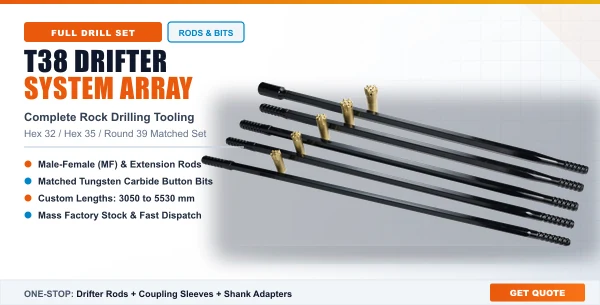
- T38-Hex35-R32: Very common for tunnel drilling. The body is 35mm hexagonal steel. It is strong and resists bending. The front end uses R32 thread for smaller drill bits.
- T38-Round39-T38: Uses a 39mm round body with T38 thread on both ends. Often used for deep hole extension drilling.
Common lengths:
- 3050 mm (10 ft)
- 3700 mm (12 ft)
- 4310 mm (14 ft)
- 4915 mm (16 ft)
How T38 Drifter Rods Are Made
Good T38 rods are made from high-strength alloy steel, such as 23CrNi3Mo or similar hollow steel. These rods must survive repeated impact, tension, compression, and flushing. So the manufacturing process is very important.
Key processes include:
- Full Carburization
Carbon is added to the inner and outer surfaces. This creates a hard, wear-resistant outer layer while keeping the core tough. - Thread Surface Quenching
The thread area is hardened to prevent galling and early thread failure under high torque. - Anti-Corrosion Protection
The flushing hole is treated to prevent rust and stress corrosion from water or air.
How to Choose and Maintain T38 Drifter Rods
To get the best ROI from your T38 rods, follow these simple rules:
- Match the rock hardness.
In very hard rock like granite or quartzite, choose Hex 35 rods. They are stiffer and reduce hole deviation and breakage. - Always use thread grease.
Grease the threads before every connection. This reduces heat and friction and can extend thread life by 20% or more. - Check rods regularly.
Look for worn or deformed threads and bent rods. If the thread tops become sharp or deformed, repair or scrap the rod. This helps you avoid a lost-in-hole accident, which costs far more time and money.
Final Thoughts
The T38 drifter rod is not just a piece of steel. It is a precision consumable that directly affects drilling speed and cost. If you choose good-quality rods that meet international standards and maintain them properly, you can better control your cost per meter in mining and tunneling projects.