How to Choose T38 Drifting Drill Rods: Round vs Hex, M/F vs M/M
Drifting Drill Rod T38: A Selection and Application Guide
Meta Description: How do you choose the right drifting drill rod T38 — cross-section, thread, and heat treatment? This article walks through the key points to confirm when sourcing and specifying, for mining and tunneling professionals.
Drifting drill rod T38 sits in the middle of a development drilling string: rock drill on one end, button bit on the other. Tunneling, mining, and civil construction all rely on it. When you are sourcing or specifying, three things — thread, cross-section, and heat treatment — largely decide your penetration rate and rod life.
What “T38” Means
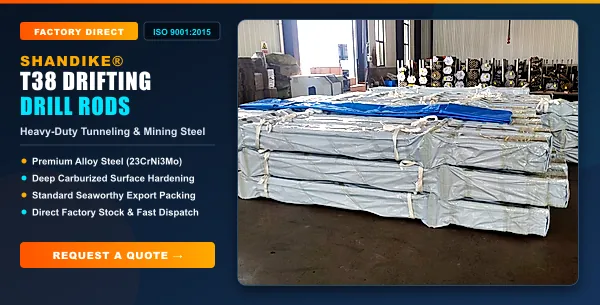
T38 is a trapezoidal thread with a nominal diameter of 38 mm. The thread profile has to take the impact and rotational torque of top hammer drilling while keeping the connection between rod sections reliable. T38 drifting rods typically run with hole diameters from 64 mm to 89 mm, depending on rod configuration and bit selection.
Round or Hex
T38 drifting rods come in two common cross-sections. Which one you pick affects handling, rigidity, and hole accuracy.
| Feature | Round 39 mm | Hex 32 / 35 mm |
|---|---|---|
| Weight & handling | Lighter, less material per length | Heavier, more rigid |
| Energy transfer | Adequate for extension drilling | More efficient, less hole deviation |
| Flushing | Standard | Better flushing thanks to the geometry |
| Best for | Extension drilling, speed rods | Tunneling, drifting, face drilling |
Round rods are lighter and cheaper to handle, which is why they see more use in extension drilling. Hex rods are stiffer, which helps curb hole deviation and improves flushing and hole cleaning — that makes them more common in tunneling and drifting.
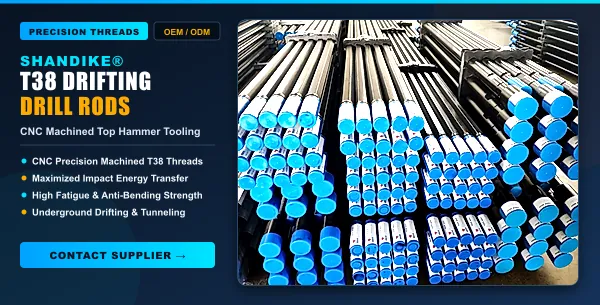
Male/Female vs. Male/Male
T38 drifting rods are usually supplied in Male/Female (M/F) configuration — the “speed rod” design. The female thread is built into the rod body, so no separate coupling sleeve is needed.
The upside of M/F rods comes down to a few things:
- Tighter connections and a more rigid drill string
- Faster uncoupling and easier handling
- Straighter holes
- Longer service life than rod-and-coupling systems
Heat Treatment: Carburizing or High Frequency
How long a rod lasts depends heavily on heat treatment. Two methods are common:
Carburizing hardens the entire surface, inside and out. It is mostly used for underground work and where water is the flushing medium, and it gives good overall wear resistance.
High frequency induction hardening hardens only the thread ends. That reduces the fragility of the drill steel and suits surface drilling with air flushing.
Many manufacturers also phosphorize the outer surface to improve corrosion resistance.
Common Specifications
Exact dimensions vary by manufacturer. Typical T38 drifting rod parameters look roughly like this:
- Thread: T38 (trapezoidal, 38 mm)
- Lengths: Common stock includes 1220 mm, 1830 mm, 3050 mm, 3660 mm, and 4270 mm; speed rods go up to 6095 mm
- Flushing hole: Generally 9.5 mm to 14.5 mm, depending on the rod series
- Material: High-strength alloy steel, usually 22CrNi3Mo grade
What to Confirm Before Ordering
Before you place an order for T38 drifting rods, it is worth nailing down the following with your supplier:
- Cross-section: Round 39 mm or hex 32/35 mm, based on your rig and hole-straightness requirements.
- Connection type: M/F (speed rod) or M/M, and whether a coupling sleeve is needed.
- Effective length: Must match your feed length and planned hole depth.
- Heat treatment: Carburized for water-flushed underground work, induction-hardened for surface air-flushed drilling.
- Flushing hole diameter: Should match your planned air or water volume.