Carburized T38 Drill Rod: Why Heat Treatment Determines Rod Life
Carburized T38 drill rods occupy a specific niche in top hammer drilling: they cost more than surface-hardened alternatives, but deliver measurably longer service life in the right conditions. The difference lies not in the thread profile or steel grade alone, but in how deep the hardening goes—and whether that depth matches your rock formation.
This article examines what carburizing actually does to a T38 rod, when it outperforms surface hardening, and what to verify before placing an order.
What Carburizing Does to a T38 Rod
Carburizing is a case-hardening process conducted in a carbon-rich atmosphere furnace. Carbon atoms diffuse into the steel surface—both the outer rod body and the internal flushing hole walls—creating a hardened case after quenching and tempering. The result is a surface hardness of roughly HRC 58–60 while the core remains around HRC 43.
For T38 rods, this translates to a wear-resistant exterior that resists thread flank flattening and rod body abrasion, paired with a core tough enough to absorb percussive shock without cracking. The hardened case adheres metallurgically to the base material rather than sitting as a separate layer, which is why carburized rods typically exhibit better fatigue endurance than induction-hardened equivalents.
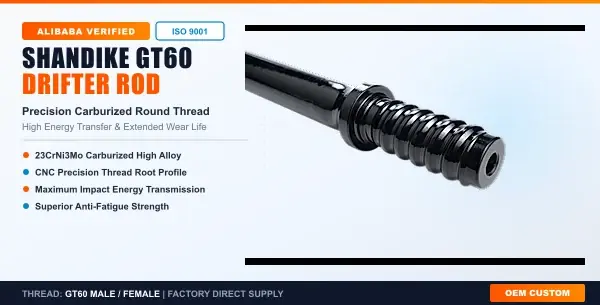
Industry practice for quality T38 carburized rods centers on 23CrNi3Mo alloy steel run through an extended carburizing cycle. Some manufacturers specify a 20-hour deep case process, which produces a deeper hardened zone than standard cycles and extends the interval before thread wear forces a rod out of service.
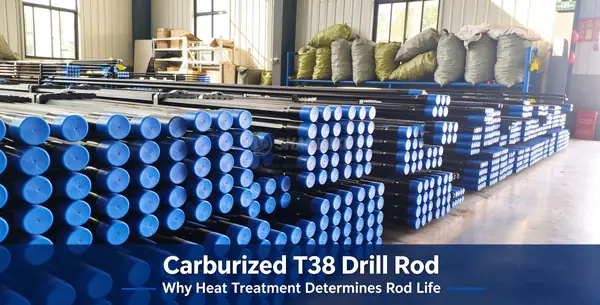
Carburized vs. Surface-Hardened T38: When to Choose Which
The choice is not about one process being universally superior. It is about matching the heat treatment to the failure mode your drilling conditions are most likely to produce.
Surface-hardened T38 rods (induction hardened at the thread ends only) retain greater overall toughness because the core material avoids the carburizing cycle. This makes them better suited to fractured, interbedded, or unstable rock formations where shock loads are unpredictable and brittle failure is the primary risk. They are also generally less expensive.
Carburized T38 rods excel where wear is the dominant failure mode. In abrasive formations such as granite and quartzite, the hardened case resists the gradual erosion that eventually renders a rod unusable. Carburized rods are also the preferred choice for deep-hole drilling beyond 20 meters, where their fatigue resistance helps control hole deviation and extend the overall drilling assembly life. Underground operations using water as the flushing medium also benefit from full carburization, as the internal hole walls receive the same hardening treatment as the exterior.
A practical distinction: if your rods typically fail by thread wear or body abrasion, carburizing addresses that directly. If they fail by snapping in bad ground, surface-hardened rods may actually serve you better despite their shorter nominal wear life.
What to Verify in a Carburized T38 Supplier
The carburizing label is not self-certifying. Two suppliers can both claim “carburized T38” while delivering very different case depths and consistency.
Case depth and cycle time. Ask for the specified case depth, not just the surface hardness. A deeper case takes longer to wear through, but over-carburizing can embrittle the surface. Reputable manufacturers control carbon potential and cycle duration precisely; vague answers about “standard carburizing” are a warning sign.
Steel grade confirmation. The 23CrNi3Mo grade is widely cited for T38 rods because its chromium and nickel content supports both hardenability and core toughness. Substituting generic carbon steel undermines the entire point of carburizing.
Batch traceability. Request heat-treatment records tied to the product code on the batch you receive. A spec sheet describing the process is not the same as documentation proving that specific batch went through it.
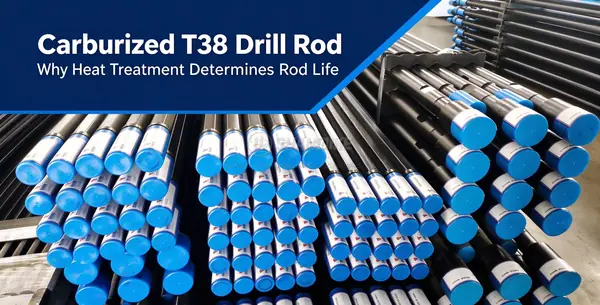
Sourcing Carburized T38 Rods from SHANDIKE
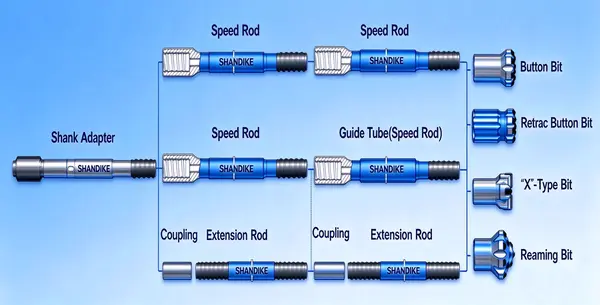
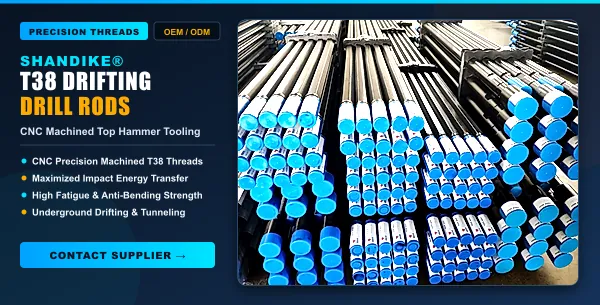
SHANDIKE manufactures carburized T38 drill rods in the configurations most commonly requested for bench and underground drilling: Round 39 MF rods, extension rods, and Hex 35 drifter rods. The production line uses 23CrNi3Mo alloy steel with controlled carburizing cycles, and the company’s technical team can advise on whether carburized or surface-hardened T38 is the better fit for a specific rock formation and drilling depth.
For operations running mixed fleets, SHANDIKE’s range covers top hammer drilling tools alongside DTH tooling, allowing rods, bits, and couplings to be sourced with matched thread specifications. Technical inquiries receive a response within 30 minutes, with solution designs provided within 24 hours.
A note on procurement: Carburized T38 rods carry a higher unit price than surface-hardened alternatives, and the cost justification depends entirely on whether your failure mode is wear rather than breakage. If you are uncertain which treatment suits your ground conditions, the more reliable path is to describe the rock type, hole depth, and typical failure pattern to a manufacturer’s technical contact before ordering—rather than defaulting to whichever option is cheaper per piece.