T51 Drill Rods: Technical Guide for Deep Hole Drilling
2025.12.09Shandike eason
T51 drill rods, as core tools in deep-hole drilling operations, have become the preferred choice in fields such as mining, geological exploration, hydrogeological engineering, and geothermal development due to their exceptional strength, wear resistance, and fatigue resistance. This article provides an in-depth analysis of the technical characteristics, application scenarios, selection considerations, and maintenance recommendations for T51 drill rods. It aims to assist clients in selecting the most suitable drilling solution based on actual working conditions, thereby maximizing efficiency and optimizing costs.
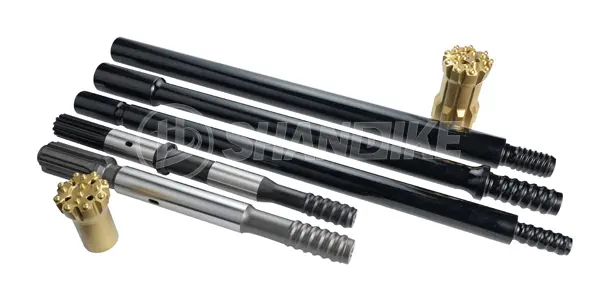
1. Core Technical Features of T51 Drill Rods
1.1 Material and Manufacturing Process
- High-Strength Alloy Steel: Made from special alloy steel and subjected to precision heat treatment (such as quenching and tempering), T51 rods achieve high yield strength (typically ≥760 MPa) and excellent toughness, making them suitable for deep drilling under high torque and axial pressure.
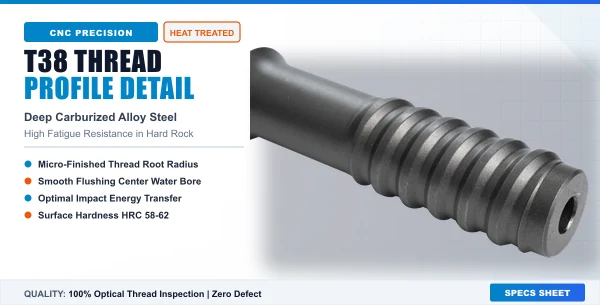
- Optimized Thread Design: Typically conforms to API standards or features specially reinforced threads (e.g., wave threads), ensuring high connection strength, excellent sealing performance, reduced stress concentration, and extended service life.
- Surface Treatment Technology: Enhanced surface hardness (up to HRC 45–55) through processes like carburizing, quenching, or shot peening, significantly improving wear and corrosion resistance.
1.2 Structural Design Advantages
- Thick-Wall Pipe Body: The wall thickness is approximately 15%–20% greater than that of conventional drill rods, improving bending and torsional resistance, making them suitable for complex formations (e.g., fractured zones, hard rock layers).
- Excellent Hydraulic Performance: The smooth inner bore and optimized diameter ensure efficient flushing fluid circulation, effective cuttings removal, and drill bit cooling.
1.3 Performance Parameters Overview
- Applicable Hole Diameter Range: Typically used for hole diameters ranging from 60–152 mm (depending on the drill bit type).
- Maximum Drilling Depth: Capable of reaching 800–1500 meters in hard rock formations, depending on rig capacity and ground conditions.
- Compatibility: Can be used with various down-the-hole hammers, roller cone bits, or diamond bits, adapting to different drilling methods such as percussion drilling and rotary drilling.
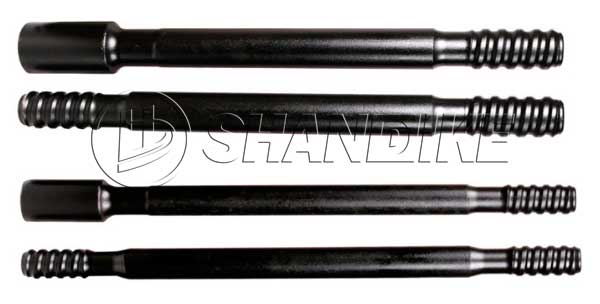
2. Application Scenarios: Why Choose T51 Drill Rods?
2.1 Mineral Exploration and Mining
- Deep Ore Body Exploration: In deep exploration for metal ores (e.g., gold, copper, iron), T51 drill rods withstand high-load continuous operations, ensuring core recovery quality and drilling efficiency.
- Blast Hole Drilling: Used for pre-split blast holes in large open-pit mines, their high rigidity ensures hole wall stability and vertical accuracy.
2.2 Water Well and Geothermal Engineering
- Deep Water Well Construction: For drilling deep water wells (>500 meters) in bedrock formations, the fatigue resistance of T51 rods handles alternating loads effectively.
- Geothermal Well Development: Suitable for medium-to-deep geothermal wells (temperatures up to 150°C or higher), with materials specially treated for enhanced heat and sulfide corrosion resistance.
2.3 Complex Geological Conditions
- Hard Rock and Fractured Zones: In hard formations such as granite and quartzite, T51 rods efficiently transmit high impact energy while minimizing breakage risks.
- Inclined and Directional Drilling: When used with directional drilling equipment, their high bending strength helps maintain trajectory accuracy.
3. Selection Guide: Key Factors to Match Client Needs
3.1 Based on Drilling Method
- Percussion Drilling (DTH Hammer): Prioritize T51 rods with reinforced threads to ensure connection integrity under high-frequency impacts.
- Rotary Drilling (Core/Full-Face Drilling): Focus on rod straightness and inner wall smoothness to reduce core blockage and pump pressure loss.
3.2 Adaptation to Formation Conditions
- Homogeneous Hard Rock: Standard T51 drill rods are sufficient.
- Fragmented, Highly Abrasive Formations: Recommend surface-hardened or wear-band-equipped rods to extend service life.
3.3 Economic Considerations
- Long-Term Projects: Invest in high-quality T51 rods. Although initial costs are higher, they reduce replacement frequency and downtime.
- Short-Term or Shallow Hole Projects: Consider leasing or cost-effective models.
4. Best Practices for Operation and Maintenance
4.1 Usage Precautions
- Torque Control: Strictly follow manufacturer-recommended torque values during make-up to avoid thread damage from over-torquing.
- Flushing Fluid Management: Ensure flushing fluid cleanliness and flow rate to prevent cuttings accumulation and sticking.
- Proper Tripping Procedures: Use dedicated tongs to avoid pipe body damage; support rods with pads during storage to prevent bending.
4.2 Routine Maintenance Points
- Thread Care: Clean threads and apply specialized grease after each disassembly; regularly inspect for thread wear.
- Fatigue Life Monitoring: Record cumulative usage time/meterage; conduct periodic magnetic particle inspection to detect micro-cracks early.
- Storage Conditions: Store in a dry environment; avoid long-term outdoor storage to prevent corrosion.
4.3 Common Issues and Solutions
- Premature Thread Wear: Check if tongs are compatible and if make-up torque is accurate.
- Localized Pipe Bending: Avoid excessive pressure in complex hole sections; use stabilizers to assist drilling.
- Inner Wall Scaling: Perform regular chemical or mechanical cleaning to maintain inner diameter clearance.
5. Future Development Trends
- Smart Integration: Future T51 rods may embed sensors to monitor stress, temperature, and other data in real time, enabling predictive maintenance.
- Material Innovation: The application of nano-coatings and higher-strength, lightweight alloys will further enhance rod durability and efficiency.
- Green Manufacturing: The use of eco-friendly heat treatment processes and recyclable materials will reduce environmental impact throughout the product lifecycle.