T51 Drill Rod Fracture Analysis and Prevention Recommendations
2026.04.27Shandike eason
T51 Drill Rod Fracture Analysis and Prevention Recommendations
Fracture of the T51 drill rod is typically not caused by a single factor, but rather by the combined effect of stress concentration and material fatigue under extreme operating conditions.
The following is an analysis of the main causes of T51 drill rod fracture and corresponding prevention recommendations:
1. Improper Mechanical Operation and Construction (most common trigger)
- Empty Blasting / Blank Firing: Continuing to apply impact when the drill bit is not fully in contact with the rock or after the rock has already been broken. This prevents the piston’s enormous energy from being transmitted to the rock; instead, it is absorbed by components such as the drill rod and coupling, easily leading to brittle fracture of the rod.
- Poor Alignment and Bending Stress: If the drifter, drill rod, and borehole are not in a straight line (angle deviation <85° or >95°), the drill rod will experience significant lateral bending forces during rotation and impact. This repeated bending generates microscopic fatigue cracks in the rod body, which then propagate rapidly.
- Improper Feed Pressure: Excessive feed pressure causes rod bending; insufficient feed pressure leads to loose connections and creates a “blank firing” effect. Both accelerate fatigue fracture.
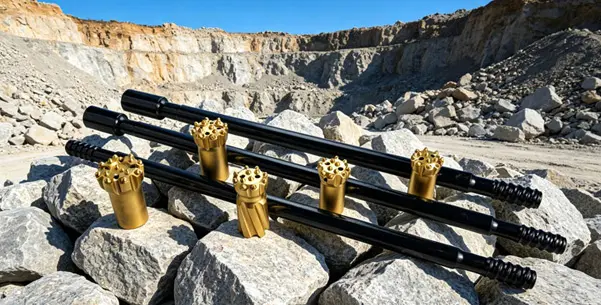
2. Thread Connection Issues (core of stress concentration)
- Thread Damage and Galling: The T51 thread is the core of force transmission. If lubrication is inadequate or the threads are contaminated, galling occurs, resulting in uneven stress distribution and eventual fracture starting at the thread root.
- Loose Connections: If the connection is too loose, impact energy generates strong vibration and rebound within the thread gap, causing severe impact and stress concentration at the thread root.
- Mixing Worn and New Components (e.g., old rod with new coupling or vice versa): Heavily worn threads increase clearance, reduce energy transmission efficiency, and induce cracks. Mixing severely worn couplings with new drill rods is strictly prohibited.
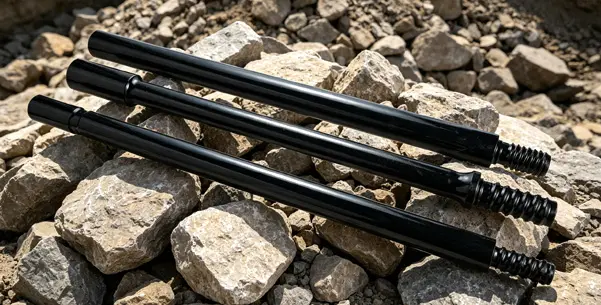
3. Material Fatigue and Environmental Factors
- Alternating Stress Fatigue: The T51 drill rod undergoes high-frequency impact of approximately 2,000 blows per minute, involving combined stresses such as tension, compression, bending, and torsion. When the number of stress cycles reaches the material limit, cracks initiate from surface imperfections (e.g., scratches, corrosion pits).
- Thermal Effects and Overuse: Continuous operation exceeding 40 minutes or poor lubrication can cause connection temperatures to exceed 200°C, reducing metal hardness and increasing brittleness.
- Corrosion Acceleration: In humid or acidic environments (e.g., underground mines), water corrosion accelerates crack propagation – a phenomenon known as corrosion fatigue.
4. Prevention and Improvement Recommendations
- Standardized Operation: Strictly avoid blank firing. Ensure the drill bit is pressed firmly against the rock before applying impact. During collaring, reduce power to ensure proper alignment.
- Enhanced Lubrication: Use a specialized thread compound with a zinc content of at least 50%. Inspect thread cleanliness before each rod coupling.
- Regular Inspection: Timely replace threads that have worn beyond the limit or rods with severe scratches. Do not continue operating with damaged equipment.
- Select High-Quality Products: Prioritize alloy steel rods that have undergone deep case carburization heat treatment, such as those from SHANDIKE and similar brands.